
Signs Your Child May Need Therapy: A Parent Guide by Age

Plenty of parents who call a therapist are not sure they should be calling. They have been watching something for weeks, and they cannot tell whether it is a phase or a problem.
That uncertainty is reasonable. A seven-year-old who melts down over a lost sock and a fifteen-year-old who stops coming out of their room are both doing something a little alarming and possibly nothing at all. The honest answer is that it depends almost entirely on the child’s age, and that is the part most articles on this subject leave out.
What follows is a guide organized the way parents actually experience the question: by how old your child is, what is genuinely typical at that stage, and what is worth a phone call.
Key Takeaways
- Anxiety diagnoses in Ohio children climb steeply with age, from 2% of 3–5 year olds to 20% of 12–17 year olds, so the same behavior means different things at different ages (Health Policy Institute of Ohio, December 2024).
- Duration alone is a crude test. Most guidance says “if it lasts two weeks” — but two weeks of withdrawal at six is a different matter from two weeks of withdrawal at sixteen.
- The clearest signal at any age is not one dramatic behavior. It is the same difficulty showing up in more than one place: home, school, and friendships.
- Distress in children tends to surface during the school year, not over the summer. Pediatric emergency visits for depression and self-harm run up to twice as high in school semesters (CDC MMWR, September 2023).
- You do not need a diagnosis, a referral, or certainty to make a first call. Noticing that something is hard is reason enough.
How do I know if my child needs therapy?
The practical test is whether the difficulty is showing up in more than one part of your child’s life, and whether it is getting in the way of the things a child that age should be able to do.
A child who is short-tempered at home but fine at school and steady with friends is usually navigating something specific. A child who is short-tempered at home, struggling at school, and losing friendships is telling you something broader. Cleveland Clinic child psychologist Kristen Eastman, PsyD, uses problems across multiple settings as the first item on her list of signs a child may need a therapist, alongside changes in sleep, hygiene or appetite, and withdrawal from activities a child used to enjoy (Cleveland Clinic, April 2025).
The second test is trajectory. A hard week after a hard event is expected. A hard month that is getting harder, with no obvious cause resolving, is worth a conversation.
Why your child’s age changes the answer
Age is not a detail here. It changes both what is normal and what the warning signs look like, because the same underlying distress expresses itself completely differently at six and at sixteen.
The Ohio data makes the scale of that shift visible. Among Ohio children, current anxiety diagnoses rise from 2% in the preschool years to 8% in elementary school to 20% among teenagers — a tenfold increase across childhood.
That pattern has a practical consequence. Anxiety in a six-year-old is uncommon enough that a sudden onset deserves attention. Anxiety in a sixteen-year-old is common enough that the question becomes one of degree: is this manageable worry, or is it stopping them from doing things they want to do?
Ages 5 to 7
At this age children have big feelings and very few words for them, so distress tends to come out through the body and through behavior rather than through anything a child can explain.
| Usually developmentally typical | Worth a call |
|---|---|
| Meltdowns when tired, hungry or overwhelmed | Meltdowns that last far longer than the trigger warrants, most days, for weeks |
| Separation worry at drop-off that settles within minutes | Separation distress that is getting worse over a term rather than better |
| Occasional nighttime accidents during a stressful stretch | Losing a skill they had firmly established — toileting, sleeping alone, speech — with no medical cause |
| Imaginary fears: the dark, monsters, the drain | Fears that stop them going to school, sleeping, or visiting friends |
| Stomachaches before a new or hard thing | Frequent stomachaches or headaches with no medical cause, checked by a pediatrician |
Regression — a return to bedwetting, baby talk, or intense clinginess after those stages had passed — is the sign most specific to this age group. It rarely means a child is being difficult. It usually means they are carrying something they cannot say.
Ages 8 to 10
Children this age have language for feelings but limited willingness to use it, particularly about anything they find embarrassing. School becomes a sharper mirror, because academic and social demands both step up.
| Usually developmentally typical | Worth a call |
|---|---|
| Friendship churn, including falling out and making up | No stable friendships at all, or active exclusion that has persisted for months |
| Dislike of a subject or a teacher | A clear drop in grades in a child who was previously doing fine |
| Worrying about tests and performance | Worry they describe as impossible to stop, or that keeps them awake |
| Wanting more privacy | Dropping an activity or sport they have loved for years |
| Fidgeting, nail-biting under stress | Repetitive self-directed behavior such as hair-pulling or skin-picking |
One pattern specific to this band is worth knowing. Among young people seen for anxiety, the condition that most often accompanies it differs by age: for children roughly 8 to 12 it is more often ADHD or a behavior disorder, while for teenagers it is more often depression (NCHS Data Brief No. 567, August 2026). Half of those visits carried a second diagnosis alongside the anxiety. In practice this means that what looks like a focus problem at nine is sometimes a worry problem, and the two are easy to confuse from the outside.
Ages 11 to 14
This is where the Ohio numbers start to move sharply, and where parents most often tell themselves they are simply dealing with adolescence.
| Usually developmentally typical | Worth a call |
|---|---|
| Wanting more time alone and more privacy | Withdrawal from everyone, including the friends they chose |
| Moodiness and irritability, especially at home | Irritability that has become the default setting for weeks |
| Caring intensely what peers think | Avoiding school, or avoiding social situations they used to manage |
| Testing rules and pushing back | Aggression, fighting, or threats toward others |
| Shifting sleep — later nights, harder mornings | Sleeping far more or far less than usual, for weeks, with daytime exhaustion |
Across Ohio, the share of students reporting their mental health was not good most or all of the time rises from 10% in sixth grade to 26% in eighth (Health Policy Institute of Ohio, December 2024).
Ages 15 to 18
Older teenagers are better at hiding distress and better at explaining it away, which makes this the age where parents most often second-guess what they are seeing.
| Usually developmentally typical | Worth a call |
|---|---|
| Pulling away from family toward friends | Pulling away from everything, including friends |
| Stress about grades, college, the future | Hopelessness about the future, or saying nothing they do matters |
| Strong opinions, strong emotions | Persistent sadness most days for two weeks or more |
| Experimenting with identity, style, interests | A sharp drop in self-care — hygiene, eating, sleep |
| Wanting independence and resisting check-ins | Any talk of self-harm, or of not wanting to be here |
The Ohio data holds a genuine surprise about this age band. Distress does not peak in senior year, when the pressure seems highest. It peaks in eleventh grade, where 47% of students report poor mental health — and then falls again in twelfth.
The data does not say why the peak falls where it does. What it does say is that if you have a tenth or eleventh grader, this is the stretch to pay closer attention — not senior year, where most parents expect the pressure to be worst.
Signs that matter at every age
A few signals do not depend on how old a child is, and they warrant a call rather than a wait.
- Any statement about self-harm or not wanting to be here. This includes indirect versions — “nobody would notice if I disappeared,” “I wish I weren’t here.” Take it at face value and seek support.
- A clear change following a specific event: a death, a divorce, an accident, or anything frightening your child witnessed.
- Loss of interest in nearly everything, rather than in one specific activity.
- Your own instinct that something has changed. Parents notice shifts in their own children before any screening tool does.
If your child is in immediate danger, call 911. The 988 Suicide & Crisis Lifeline is available 24 hours a day by call or text for anyone — including parents who are worried about a child and unsure what to do next.
Why this often surfaces in October, not July
A child who seemed fine all summer and falls apart by mid-autumn raises an obvious question: is school the cause, or the trigger?
The pattern is real and measurable. Analyzing pediatric emergency department visits across 46 states from 2018 to 2023, the CDC found that visits for depressive disorders, suicidal ideation and self-harm, and trauma-related disorders among 10 to 17 year olds ran up to twice as high during school semesters as during the summer, with the same shape at lower volume among 5 to 9 year olds (CDC Morbidity and Mortality Weekly Report, September 2023).
Two things follow from this. A child who struggles only during the school year is not faking it, and the structure and demands of school are genuinely part of the picture. And a summer improvement does not necessarily mean the underlying difficulty resolved — it may mean the demand lifted.
What the research says about waiting
Waiting is a reasonable instinct, and the reasoning behind it is sound: children change quickly, and many difficulties do pass.
The counterweight is when mental health conditions tend to begin. A meta-analysis of 192 studies covering 708,561 people found that 34.6% of mental disorders have their onset before age 14, and 48.4% before age 18, with a peak onset age of 14.5 years (Solmi et al., Molecular Psychiatry, 2021). The years when parents are most inclined to attribute changes to adolescence are the same years when conditions most often start.
This is not an argument for treating every rough patch as clinical. It is an argument against assuming time will resolve a pattern that has already persisted for a month or more.
Access is a real factor in that decision too, and it works in a direction most families do not expect. The Health Policy Institute of Ohio reports that families with private or commercial insurance frequently have more difficulty finding treatment than families with Medicaid, and that families seeking care for younger children — roughly ages 6 to 11 — report more difficulty than families of older children. Seventy-five of Ohio’s 88 counties were designated mental health professional shortage areas as of July 2025 (Health Policy Institute of Ohio, December 2025). If you are weighing whether to start looking, the search itself can take longer than families expect.
What happens when you actually reach out
Ohio does not publish data on how long families wait for children’s mental health care — the Health Policy Institute of Ohio names this as one of the state’s clearest data gaps. So rather than generalize, here is what the process looks like at our Bay Village child and teen practice.
You send a short form or call. Julie responds the same business day and sets up a free 15-minute consultation — and that consultation is with the therapist who would actually see your child, not an intake coordinator. Parents are welcome to join. If it is a fit, most families have a first session within about a week, schedules permitting.
The first session itself is designed to remove the guesswork. For a younger child, you and your child meet the therapist together for the first half: policies, confidentiality, your questions, and a walk through the intake forms so you can add the things that were hard to write down. For the second half, you wait in the lobby while your child has one-on-one time and starts building trust. For a teenager, your teen decides whether you join; either way the therapist spends a few minutes with you on policies and confidentiality.
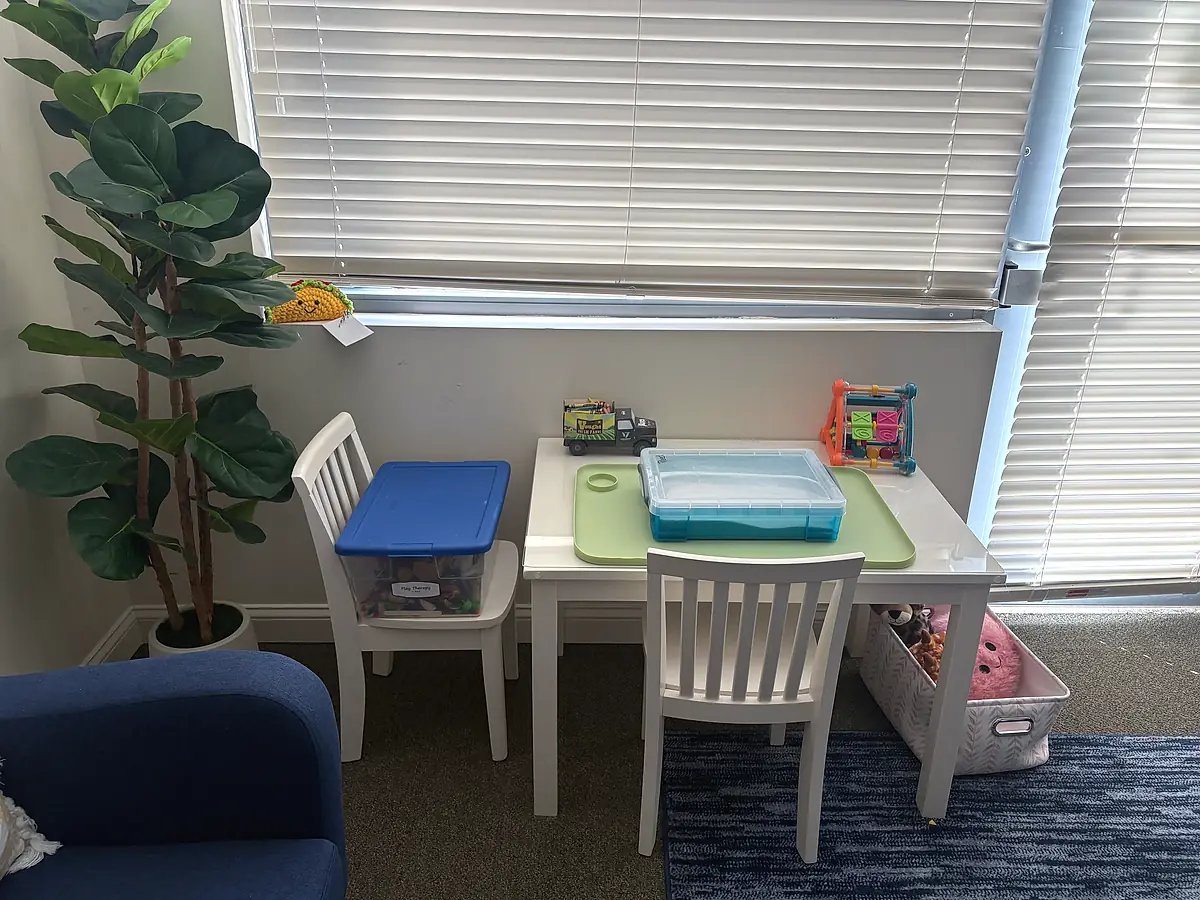
After that, parents stay in the loop: a check-in after sessions, questions welcome at any time rather than saved for the next appointment, and parent-only meetings when there is something more private to talk through. For younger children much of the work happens through play, art and storytelling rather than conversation, which is how children that age process things most naturally.
Frequently asked questions
Does my child need a diagnosis before starting therapy?
No. Most families reach out because something at home feels hard, not because they have a label. The first session is about getting to know your child and understanding what is going on; anything diagnostic is the therapist’s job to work out with you over time, not something you need to arrive with.
Do I need a referral from our pediatrician?
Not in Ohio. The state rule covering outpatient behavioral health with licensed professionals in private practice (Ohio Administrative Code 5160-8-05) does not require a physician referral. A pediatrician’s input is useful, particularly for ruling out medical causes of physical symptoms, but it is not a gate you have to pass through first. Your insurance plan may have its own requirements, so it is worth one call to the number on your card. We cover this in more detail in our guide to what Ohio Medicaid covers for children’s therapy.
What if I am wrong and my child is fine?
That is a good outcome, not a wasted call. A consultation that ends with “this sounds developmentally normal, here is what to watch for” is genuinely useful information, and it costs you fifteen minutes.
My child says they do not want to go. Now what?
Common, especially with teenagers. For a teen, having some control over the process helps — including whether you sit in on the first session. For younger children, framing it as time with someone whose job is helping kids with big feelings tends to land better than framing it as a problem to be fixed.
Is it too late if my child is already 17?
No. The onset data explains why adolescence matters, not why it is a deadline. Many older teenagers engage well with therapy precisely because they can articulate what is going on.
Where to start
If you have read this far, you are probably not looking for permission — you are looking for a sense of whether what you are seeing crosses a line. The honest answer is that the line is blurry, and that is exactly what a consultation is for.
Reed Counseling offers child and teen therapy in Bay Village for ages 4 to 18, including after-school appointments. Taylor Maddox, LSW, works with children through play, art and storytelling, and with teens using practical skills-based approaches. The first conversation is free, fifteen minutes, and with Taylor herself.
Request a free 15-minute consultation — or call (440) 742-4425. We reply the same business day.
If the thing your family is working through is a separation or divorce, our guide to helping a child through a divorce covers what tends to help at each age.
About the author. Taylor Maddox, LSW, is a Licensed Social Worker who earned her master’s degree from Ohio State University. She works with children and teens ages 4 to 18 at Reed Counseling in Bay Village, Ohio, using play, art and storytelling with younger children and CBT, DBT and motivational interviewing with teens. Taylor works under the clinical supervision of Julie Reed, LPCC-S, founder of Reed Counseling, and also receives clinical training supervision from a licensed independent social worker.
This article is for general information and is not a substitute for an individual clinical assessment. If you are concerned about your child’s immediate safety, call 911 or contact the 988 Suicide & Crisis Lifeline.

Taylor Maddox
M.A., LSW
Taylor Maddox, LSW, is a Licensed Social Worker who earned her master’s degree from Ohio State University, and her work has been with children and teens throughout her studies and her career. She sees children and teens ages 4–18, working through play, art and storytelling with younger children and CBT, DBT and motivational interviewing with teens. Taylor works under the clinical supervision of Julie Reed, LPCC-S, founder of Reed Counseling.
Book a Free Consultation